Every year, around 50,000 people attempt Mount Kilimanjaro, the highest peak in Africa at 5,895 metres. Many are first-time trekkers who have never climbed anything bigger than a hill. That is the beauty of Kilimanjaro: it demands no ropes, no ice axes, and no technical skill — only preparation, patience, and a good team behind you. Here is what we tell every first-timer before they set foot on the mountain.
Choose Your Route Carefully
Kilimanjaro has several established routes, and your choice shapes your whole experience. The Machame route, often called the Whiskey route, is the most popular: scenic, varied, and well-designed for acclimatisation over six or seven days. The Lemosho route approaches from the west and is widely considered the most beautiful, with quieter trails and excellent summit success rates over seven or eight days.
The Marangu route, the Coca-Cola route, is the only one with hut accommodation instead of tents — but its shorter five-day itinerary gives your body less time to adjust, and summit success rates suffer for it. The Rongai route approaches from the drier north and is a great choice during the rainy shoulder seasons.
Our advice is simple: take more days, not fewer. The single biggest factor in reaching the summit is acclimatisation time. Seven days beats six; eight beats seven.
Altitude Is the Real Challenge
Kilimanjaro's difficulty is not the walking — most days cover just four to seven hours at a gentle pace. The challenge is altitude. Above 3,500 metres the air thins noticeably, and by the summit you are breathing roughly half the oxygen you would at sea level.
The golden rules: walk slowly (you will hear your guides say pole pole — slowly slowly — a hundred times a day), drink three to four litres of water daily, and be honest about how you feel. Mild headaches are normal; our guides are trained to monitor every climber twice daily with pulse oximeters and to act immediately if symptoms worsen.
Training: Hike, Don''t Sprint
You do not need to be an athlete, but you should arrive fit enough to enjoy the trek rather than survive it. The best training is exactly what you will do on the mountain: long walks, ideally on hills, ideally on consecutive days, carrying a light daypack. Start eight to twelve weeks out. Add some general cardio and leg strength work, and break in your boots completely — blisters have ended more summit bids than altitude sickness.
What the Summit Night Is Really Like
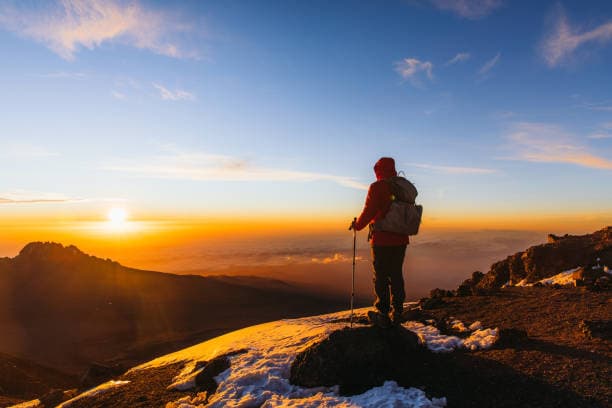
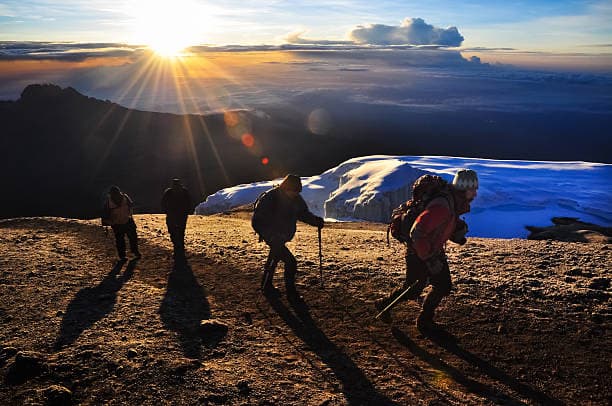
Summit night begins around midnight. You climb by headlamp through the cold — often minus 10 to minus 15 degrees Celsius — zigzagging up scree for five to seven hours to reach Stella Point on the crater rim, then walking another 45 minutes to Uhuru Peak as the sun rises over Africa.
It is the hardest physical thing many of our guests have ever done, and almost all of them describe it the same way afterwards: worth every step. Watching dawn break above the clouds, with the glaciers glowing pink and the curve of the Earth visible at the horizon, is a memory that stays with you for life.
When to Climb
The best windows are January to mid-March and June to October — drier trails, clearer skies, better summit views. January and February are slightly warmer and quieter; August and September are the most popular.
The Team Makes the Mountain
A Kilimanjaro climb is a team effort. Behind every climber stands a crew of guides, cooks, and porters who carry the camp, prepare hot meals at altitude, and encourage you through the tough moments. Climbing with a responsible operator that treats its crew fairly is not just ethical — it directly affects your safety and your summit chances.
Kilimanjaro is waiting, and it is more achievable than you think. Train honestly, choose a longer route, walk slowly, and let a great team take care of the rest. See you at the top.